One asks for a week of your life. The other asks for a few days, six times a year.
That is the real difference between laser resurfacing and a chemical peel, and it matters more than the depth charts most comparisons lead with. Both remove damaged skin so healthier skin replaces it. What separates them is how much they take at once, which determines your recovery, your budget, and whether you actually finish the treatment you started.
Neither is better. Our providers have been performing both since 2018. Here is how to tell which one fits you.
Key Takeaways
- Laser resurfacing vs chemical peel comes down to depth, downtime, and whether you want one treatment or a series.
- Laser resurfacing delivers more correction per session and requires more recovery.
- Chemical peels work gradually across a series with minimal disruption.
- Peels are safer for deeper skin tones and for melasma.
- Many patients use both, at different points and for different reasons.
What Chemical Peels Do
Medical-grade peels use acid solutions to dissolve the bonds holding dead surface cells together. Those cells shed over the following days, revealing newer skin underneath.
Depth varies by solution and concentration. A light peel exfoliates the outermost layer with almost no visible recovery. A medium peel reaches deeper and produces several days of noticeable flaking. A deeper peel is not automatically better. The right depth depends on your skin type, concerns, and how much recovery you can realistically handle.
If pigmentation is your main concern, chemical peels are also among the best treatments for sun damage and brown spots, depending on how deep the discoloration sits.
What Peels Address Well
- Uneven tone and dullness
- Surface pigmentation and sun spots
- Congestion and mild acne
- Fine lines
- Rough texture
- Melasma, where gentler approaches often outperform aggressive ones
The Practical Advantages
Peels are safer across a wider range of skin tones than most laser treatments because they work chemically rather than thermally.
They are also easier to adjust. If your skin responds well, the next peel can go deeper. If it does not, the next one can be gentler.
What Laser Resurfacing Does
Laser resurfacing removes tissue with light energy rather than acid, and it reaches depths peels generally cannot.
CO2RE uses fractional technology, meaning it treats columns of tissue while leaving surrounding skin intact. That untreated tissue speeds healing considerably compared with fully ablative resurfacing.
That depth is also what separates a laser from microneedling when treating acne scars, since deeper scar tissue sits below what surface treatments reach.
What Laser Addresses Well
- Deeper wrinkles and established fine lines
- Acne scarring and textural irregularity
- Significant sun damage
- Enlarged pores
- Skin laxity, to a degree peels cannot reach
- Overall skin quality, since it stimulates collagen at depth
The Practical Trade-Off
More correction means more recovery. Expect redness, swelling, and peeling for roughly five to fourteen days depending on treatment depth.
Laser also requires more careful patient selection. Deeper skin tones carry a higher risk of pigment changes, and recent sun exposure or certain medications can make treatment inappropriate.
How Laser Resurfacing and Chemical Peels Fit Into Your Life
Most chemical peel vs laser comparisons frame this as which treatment is stronger. That is the wrong question.
Laser Is an Event
You schedule it, you take time off, and you get a substantial correction in one or two sessions. Then you maintain it for a year or more before considering another.
It suits people who would rather deal with something once and can accommodate a week or two of visible healing.
A Peel Is a Practice
You come in every four to six weeks, each visit produces a modest improvement, and the results accumulate. Downtime is a few days of flaking at most.
It suits people who cannot disappear for a week, want gradual change, and do not mind returning for a series.
That distinction is more useful than any depth chart because it predicts which treatment you will actually complete.
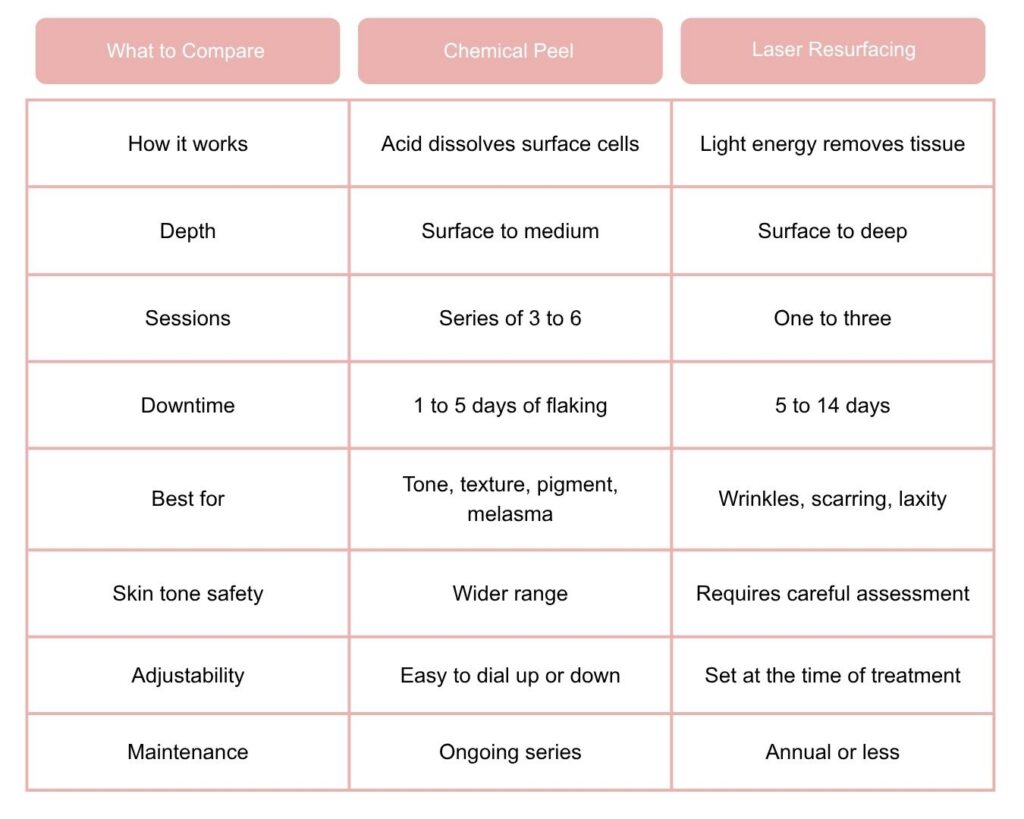
Chemical Peel vs Laser at a Glance
Here is the laser peel comparison at a glance.
Which Treatment Is Better for Wrinkles and Texture?
The answer depends on how deep the concern is.
- Start with a chemical peel for fine lines and early texture changes. Results build gradually with less downtime.
- Consider laser resurfacing for deeper wrinkles and more pronounced texture that requires treatment below the surface.
A simple clue is what happens when your face is at rest. If the line softens or disappears, a peel may be enough. If it remains visible, you may need the added depth of laser resurfacing.
Neither treatment addresses wrinkles caused primarily by muscle movement. Those typically respond to neurotoxin instead.
Chemical peel vs laser resurfacing recovery
For many people, downtime decides it.
After a Peel
Light peels produce mild redness and a day or two of subtle flaking. Most people work through it without anyone noticing.
Medium peels produce more visible peeling for three to five days, similar to a healing sunburn.
After Laser
Days one to three typically bring redness, swelling, and a sunburned sensation. Days four to seven bring more visible peeling and crusting. Residual pinkness can linger longer.
Both treatments require diligent sun protection afterward. Recent sun exposure and certain medications, including isotretinoin, may also mean postponing treatment until your skin is ready.
How Many Sessions Will You Actually Need?
Any useful laser treatment comparison has to include the number of sessions, because that is what determines how long you will be at this.
Chemical Peels
Most patients start with three to six peels spaced four to six weeks apart. Results build gradually, and maintenance peels may continue a few times a year.
Laser Resurfacing
Most patients need one to three sessions spaced several months apart, with results developing over eight to twelve weeks as collagen rebuilds.
Any chemical peel comparison has to account for that difference. A peel series spreads treatment across several months, while laser may require fewer appointments but more downtime at once. Neither is simpler; they are different kinds of commitment.
Can You Use Both Treatments?
You do not necessarily have to choose one treatment forever. Some patients use laser resurfacing for deeper correction, then add lighter chemical peels later to help maintain tone and texture. Others start with peels and move to laser if deeper wrinkles, scarring, or texture still need more correction.
Timing matters because your skin needs to fully recover between treatments. When more than one approach makes sense, layering treatments strategically can help address different concerns without trying to accomplish everything in one session.
What Each Treatment Costs
Any skin resurfacing comparison eventually gets to price, and the math works differently for each.
Chemical peels cost less per session, but you usually pay for a series of three to six treatments, plus maintenance if you want to maintain the results. Laser resurfacing costs more per session but often requires only one to three.
Neither is universally cheaper. What matters is how much correction you need and whether you would rather pay more upfront or spread treatment across several visits. Your provider can give you both estimates at your consultation so you can compare the full plan.
The cheaper option is not always the better value. A peel series that never quite reaches your concern can cost more in the end than one laser session that does.
Why Patients Come to Totality for This Decision
Totality offers both chemical peels and laser resurfacing, along with other resurfacing treatments including PicoLazer and microneedling. That gives our providers more flexibility to recommend what fits your skin rather than defaulting to one type of treatment.
Totality has been performing chemical peels and laser resurfacing since 2018 under the direction of Dr. Nicole Nadel. That experience also means we will tell you when neither option is the right fit. Every consultation starts with an assessment, not a recommendation.
Compare Laser Resurfacing vs Chemical Peel in Charleston, SC
Anyone considering laser resurfacing or chemical peel options is really asking two questions at once: what will fix this, and what can I actually fit into my life?
Bring us both questions. We will tell you what your skin needs, what recovery would look like, and whether starting gentler makes more sense than starting strong.
As a leading provider of chemical peels and laser resurfacing in Charleston, Totality Medispa has locations in Downtown Charleston, Daniel Island, Nexton, and Hilton Head, South Carolina, as well as Aledo, Texas. Call 843-900-6161 today to schedule your consultation.