
Then a good injector says something unexpected: we should probably start somewhere else.
Your facial features work together, and the area you notice is often affected by changes somewhere else. Totality’s injectors are trained to assess the face as a whole, not just the area a patient points out. Here is what that means for cheek filler vs jawline filler, and how to tell which one you should start with.
Key Takeaways
- Cheek filler restores midface volume and lifts what has descended.
- Jawline filler adds structure and definition to the lower face.
- Sagging along the jaw is frequently caused by midface volume loss, not jaw shape.
- Treating the cheeks first often improves the jawline without touching it.
- Where you start matters as much as what you treat.
Why Cheek Filler May Come Before Jawline Filler
Here is what happens as the face ages.
Midface Volume Loss Can Blur the Jawline
Fat pads in the midface lose volume and shift downward. Cheeks flatten. That descending tissue collects along the jawline, blurring the edge and creating what most people call jowls.
The jawline looks worse. But the jawline did not change. What changed is what is sitting on top of it. Understanding that one thing prevents unnecessary treatment.
Treat the Cause Before Adding Jawline Filler
Filler treatment planning starts with the cause, not the symptom. Fill the jaw without addressing the midface, and you add weight to tissue that is already heavy. Restore the cheeks first, and the lower face frequently improves on its own.
Not always. Some people have naturally soft jawlines that have nothing to do with volume loss. But often enough that any injector who skips the assessment and goes straight to the jaw is guessing.
What Cheek Filler Does
Cheek filler restores lost midface volume, helping support the areas below it.
For a cheek filler comparison, the key difference is that cheek filler restores support higher in the face rather than creating structure along the lower face.
It improves:
- Flattened or hollow cheeks
- Under-eye hollows
- Nasolabial folds
- Early midface sagging
- Cheekbone definition
The goal is not bigger cheeks, but better support and proportion. People who start here often notice a flatter, more tired appearance as volume changes over time, making the midface a common starting point for facial contouring fillers.
What Jawline Filler Does
Jawline filler builds structure, sharpens the angle at the back of the jaw, and creates more separation between the jaw and neck.
It improves:
- A soft or undefined jaw angle
- The appearance of jowls
- Poor separation between the jaw and neck
- Lower-face asymmetry
- Overall facial proportion
People who start here often have a naturally softer jawline, have already restored midface volume, or want more profile definition.
A jawline filler comparison comes down to structure: jawline filler creates definition rather than replacing lost midface volume. Providers typically use firmer products because the jaw needs to hold its shape.
Cheek vs Jawline Filler at a Glance
Here is how cheek filler compares with jawline filler when your injector is deciding where to start.
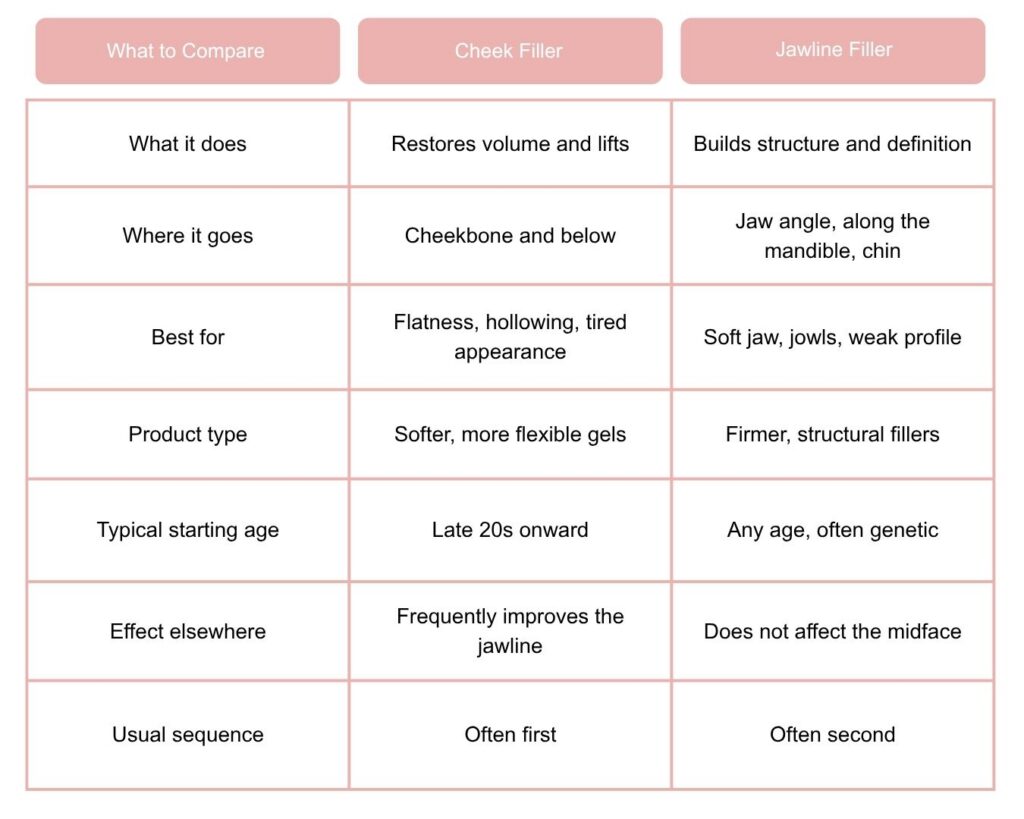
Cheek filler can improve the jawline by restoring support higher in the face. Jawline filler cannot do the same for the cheeks.
Cheek Filler or Jawline Filler First?
The answer depends on what caused the change.
Start with cheeks if your jawline used to be sharper and gradually softened. That pattern points to volume loss, and treating the midface addresses the cause rather than the result.
Start with the jawline if your jaw has always been soft, or if you have already restored midface volume and want more definition. Genetics do not respond to cheek filler.
Do both if your injector recommends it and you want the most complete result. Facial balancing fillers often involve treating more than one area, and the cheeks and jawline are one of the most common combinations we treat together.
If you are wondering which filler improves facial balance, the answer may be one area or a combination depending on your proportions and where support is missing.
How Much Filler Will I Need?
The range is wider than most people expect, and anyone quoting you a number before looking at your face is guessing.
Typical Starting Amounts
These are starting ranges, not set amounts. Your injector may recommend more or less depending on your facial structure and goals.
- Cheeks: Usually one to two syringes for a first treatment, sometimes more if volume loss is significant.
- Jawline: Often two to four syringes because the product is spread across a larger area to build definition.
The jawline may look like the smaller area, but creating a noticeable contour often takes more product than restoring volume in the cheeks. Too little can make the result barely visible.
Can Treatment Be Staged?
Your injector will give you a specific number at your consultation, along with the cost. If the total feels like more than you want to commit to, staging across two appointments is a reasonable option and often produces a better result anyway. It also gives you a chance to see how the first area settles before deciding whether you want to add more.
When Filler Is Not the Answer
Sometimes the issue is not volume at all.
Laxity Looks Like Volume Loss
Skin laxity and volume loss look similar in the mirror but respond to completely different treatments. If your skin has lost elasticity, adding filler underneath it will not tighten anything. It adds weight to tissue that is already descending, which drives most overfilled faces.
Signs You May Need Tightening Instead
- Skin that feels loose rather than flat
- Crepey texture along the jaw or neck
- Sagging that does not improve when you gently lift the skin upward
- Previous filler that did not deliver the change you expected
Totality offers Ultherapy, thread lifts, and CO2RE resurfacing alongside injectables, so your treatment plan can address skin laxity and volume loss.
How Totality Decides Where to Start
Every Totality injector trains for several months directly under Dr. Nicole Nadel before treating patients independently. That training emphasizes assessing the full face rather than treating one area in isolation.
Your injector may find that the jawline you are concerned about is not actually where treatment should begin. If restoring cheek volume improves the lower face, the plan can be adjusted before adding unnecessary filler elsewhere. That is why layering treatments strategically can produce a more balanced result than treating one area at a time.
What Treatment Involves
No matter which filler you’re getting, the process usually follows the same four steps.
- Consultation: Your injector assesses your proportions from multiple angles, identifies what is driving the change, and recommends a plan and treatment order.
- Treatment: Topical numbing first, then precise placement. Most appointments run 30 to 60 minutes depending on how many areas are treated.
- Recovery: Mild swelling, tenderness, and occasional bruising are normal and typically resolve within a few days. Most people return to normal activity immediately. Following your aftercare instructions affects how quickly everything settles.
- Results: Visible immediately, refined over two weeks as swelling resolves. Most fillers in these areas last 12 to 24 months, depending on the product and your metabolism.
Cheek and Jawline Filler Results
Filler in these areas is structural, which means the change is real but rarely obvious.
Cheek filler often prompts comments that you look rested. Jawline filler tends to produce nothing at all until someone sees a photo of you from before.
A good result should also hold up from the front, profile, and three-quarter view, which is why your injector should assess more than one angle before treating.
Neither should be obvious. If your face looks different rather than better, the placement was wrong or the volume was excessive, and both are avoidable. That is why choosing the right starting point matters.
Explore Cheek Filler vs Jawline Filler in Charleston, SC
The best way to decide between jawline and cheek contouring is to have someone assess your face properly.
Bring us the thing you notice in the mirror. We will tell you what is actually causing it, which area to treat first, and whether you need less than you thought.
As a leading provider of dermal filler in Charleston, Totality Medispa has locations in Downtown Charleston, Daniel Island, Nexton, and Hilton Head, South Carolina, as well as Aledo, Texas. Call 843-900-6161 today to schedule your consultation.